I'm Tom Acklam. I spent decades building sales and marketing software for SMBs, and now I'm building SalesCitation. This page is for SEO and GEO agencies that want their name to come up when a company asks AI who can fix its visibility in AI answers. This is my own field. SalesCitation does a version of this work, so read what follows as one practitioner's view.
HubSpot's 2026 survey of more than 1,500 marketers found that 40.6% named updating SEO for search changes as one of the top trends they are acting on, and 70.2% believe they can adapt their marketing strategy to changes in organic search such as AI Overviews.[1]
HubSpot sells marketing software, and its page gives no survey dates or method. I use the numbers to show how confident marketers say they are, and nothing more.
How do I get my SEO agency recommended by ChatGPT?
An SEO agency has to do for itself what it sells to clients. It earns a chance at a ChatGPT recommendation, by publishing specific, sourced answers under a real name on pages the crawlers can read. I can't promise it will recommend you, and neither can anybody else.
Check your own site before you check a client's. OpenAI's FAQ for publishers says not to block its search crawler, OAI-SearchBot.[2] Perplexity's documentation recommends allowing its crawler, PerplexityBot, in your robots.txt file.[3]
Then publish what you would tell a prospect on a first call. What this work can and cannot do. What you measure. How long before anything shows. What you charge. Chances are that a prospect will perform some due diligence on you before they engage you. When your prospect asks a question to Ai, will your company be cited?
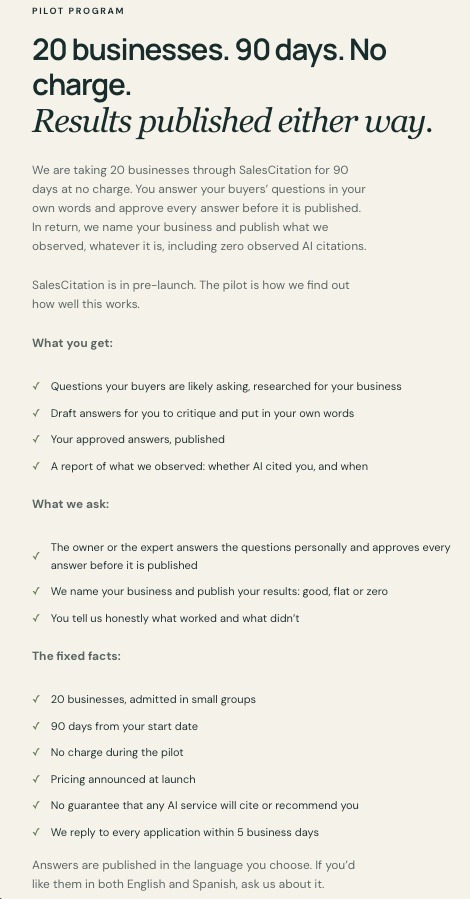
Full Disclosure: I'm in the process of building SalesCitation, I decided early that we would be transparent. We'd share what works and what doesn't. We are a startup and have zero evidence that our approach will actually work. This is why we haven't posted a price. I'm offering to help select companies attempt to be cited by Ai in exchange for feedback and the ability to use their case study. Of course, each company will have the final approval of what gets posted. This is my version of putting my money where my mouth is.
- Shows
- PILOT PROGRAM 20 businesses. 90 days. No charge.
- Date
- Came from
- SalesCitation.com
Every marketer says they're already working on AI search. How do I get in front of the ones who need outside help?
The marketers who need outside help are the ones who are doing the work and cannot tell whether it is working. In Salesforce's survey of 4,450 marketing professionals, 88% said they are in the process of optimizing for AI-driven search.[4] In HubSpot's survey, the top challenge marketers named was measuring the return on their marketing, at 33%.[1]
Those are two different surveys and neither one asked about agencies. My read is that a lot of teams have started and are finding it hard to prove a result. Neither survey shows that directly.
So publish how you measure. Which questions you track for a client. How often you check. What you count as a citation and what you count as a mention. A marketer who is stuck on proof is going to ask AI how to measure this, and that is the page they should find.
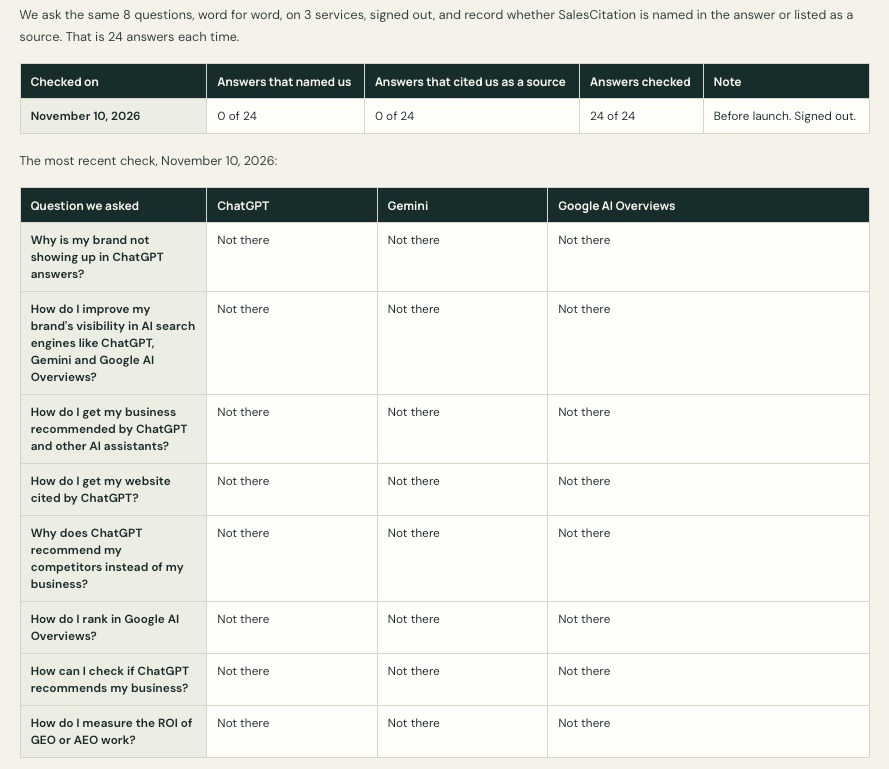
We are doing this in the following manner: A citation is when the AI answer links to one of my pages as a source. A mention is when it names my business in the answer with no link behind it. A recommendation is a step beyond both: the answer tells the buyer to consider us. We are publishing our progress on the SalesCitation experiment page.
- Shows
- The results of our testing of the system on our own company.
- Date
- Came from
- SalesCitation.com
Clients are losing clicks to Google's AI answers. How do I show up when they ask AI what to do about it?
A company that has lost clicks asks AI a plain question, and an agency gives itself a chance by answering it plainly. The question is close to "our traffic dropped, is it Google's AI answers, and what do we do?"
Start with the evidence. Pew Research Center tracked the browsing of 900 U.S. adults in March 2025. When an AI summary appeared, people clicked a regular result on 8% of visits. With no summary it was 15%. They clicked a link inside the summary on 1% of visits.[5] That is March 2025 and Google only.
Be straight about what that means for what you sell. On those numbers, people rarely clicked a link inside a summary. I would not promise a client their traffic back. I would tell them what being named is worth to them and how you will show it.
Clients think they can handle AI search themselves. How do I get found by the ones who tried and got nowhere?
Write for the team that already tried. HubSpot found 70.2% of marketers believe they can adapt to changes in organic search such as AI Overviews.[1] That is a belief, and some of them will turn out to be right.
The ones who are not will type something like "we optimized for AI search and we still are not cited, why?" Write that page. List the reasons you actually see, and how a team can check each one for itself.
Say when they do not need you. If a blocked crawler is the whole problem, show them the fix and don't charge for it. In my experience that kind of page earns more trust than a services page.
Why does ChatGPT recommend SEO software and not agencies?
I don't know why ChatGPT leans toward SEO software, and I'm not sure anyone outside OpenAI does. It may be that software companies simply publish more and get written about more.
A software product also has one name and one category. An agency is harder to pin down. So make yourself easy to pin down. Say the kind of company you work for, its size, and the one problem you fix.
Then test it. Ask the question a buyer would ask, with those details in it, and see whether agencies start to appear. Write down what you asked and what came back, with the date.
Do companies ask AI to recommend a GEO agency, or do they still Google it?
My guess is both, and nobody I know of has counted. Pew Research Center surveyed 5,119 U.S. adults in February 2026. About half said they use AI chatbots, and 42% of all the adults surveyed said they use chatbots to search for information.[6] That is the general public and it says nothing about hiring an agency.
Googling it can already mean reading an AI answer. In Pew's browsing study from March 2025, 18% of Google searches produced an AI summary.[5] So a company that says it Googled you may have read an AI answer first.
I would not pick one. Be findable in search and be worth citing in an answer. In my experience most of the work overlaps.
What should a GEO agency publish to get cited by AI?
A GEO agency should publish its method and its own numbers, with the sources behind them. Start with the research that named the field. The paper "GEO: Generative Engine Optimization" was first posted in November 2023 and accepted to KDD 2024. Its authors report that their methods can boost visibility in generative engine responses by up to 40%, and that the effect varies by domain.[7]
That is a benchmark result. It is not your client's market, and I would say so every time I quoted it.
Be careful about selling a special format. Google says a page needs to be indexed and eligible to show a snippet to appear in its AI features, and that no special markup is required.[8]
Then publish your own record. I am doing that with SalesCitation. It starts at zero AI citations, and the results, good or bad, go on a public page at salescitation.com/experiment.
Sources
- HubSpot, 2026 state of marketing: Data from 1,500+ global marketers (updated 10 April 2026)
- OpenAI, Publishers and Developers FAQ (read 17 November 2026)
- Perplexity, PerplexityBot documentation (undated; read 17 November 2026)
- Salesforce, State of Marketing Report, Tenth Edition (undated; read 17 November 2026)
- Pew Research Center, Google users are less likely to click on links when an AI summary appears in the results (22 July 2025)
- Pew Research Center, Americans and AI 2026 (17 June 2026)
- Aggarwal and others, GEO: Generative Engine Optimization (first posted 16 November 2023; revised 28 June 2024; accepted to KDD 2024)
- Google Search Central, AI features and your website (read 17 November 2026)