I'm Tom Acklam. I spent decades building sales and marketing software for SMBs, and now I'm building SalesCitation. This page is for B2B ecommerce and customer portal development agencies that want their name to come up when a manufacturer or distributor asks AI who can build its ordering portal.
Salesforce surveyed 3,450 commerce professionals in 20 countries for its 2026 State of Commerce report. Its article on the B2B findings, published in August 2026, says in its FAQ section that 54% of B2B buyers already handle purchasing without a sales rep, and that 79% of commerce organizations report more traffic from AI search tools.[1]
Salesforce sells commerce software, and the article ends by pitching it. The people surveyed work in commerce in many countries. They are not U.S. manufacturers choosing a developer. The article gives no survey dates. I read its figures as one vendor's count and no more.
How do I get my ecommerce agency recommended when companies ask AI about B2B portals?
An ecommerce agency gives itself a chance at that recommendation by describing its portal work on open pages, in plain text. Nobody can promise you the recommendation, and that includes me.
Portal agencies have a problem most agencies don't. The best work sits behind a client's login, where no crawler can read it. Google's guidance on its AI features says a page must be indexed and able to show a snippet, and it lists having important content in text form among its basics.[2] A screenshot gallery and a line that says "custom B2B portals" give AI very little to quote.
So write out what a logged-in customer can do in a portal you built. Then answer what a company asks before it commits. Will each customer see their own contract price? Does it connect to the ERP we already run? Who keeps it running after launch? What should a company our size expect to pay?
Everyone wants AI agents for ordering now. How do I get that work?
The agent work B2B companies have put into use so far is mostly behind the scenes, so write about that work. Salesforce's article says 30% of B2B organizations already use AI agents in production and another 45% plan to deploy within six months.[1] It also says B2B deployments lean toward order routing, fulfillment and supply chain work, ahead of chat on the storefront.
That is a vendor describing its own market, so I would not take "everyone" from it. The same article says where companies report results. Between 66% and 68% of B2B organizations reported moderate or major improvement from automating quote generation, real-time inventory availability and contract pricing.[1]
Pick one of those jobs you have done and write it up as a page. For example, a reorder that used to need a phone call, or a quote that used to take days. Say what the client ran before, what you connected and what it took.
Put the hard part on the page too. Only 27% of all the organizations in the survey, B2B or otherwise, had fully unified customer data.[1] If a prospect's pricing lives in three systems, tell them the data has to be cleaned up first and what that costs.
Why does ChatGPT recommend Shopify and Salesforce but never an agency?
I don't know why ChatGPT names platforms and leaves agencies out, and I doubt anyone outside OpenAI can say for certain. It may come down to how the question is asked. "What should we use for a B2B portal?" asks for a product, and products come back.
Test the question a company asks when it needs a builder. Something like: "We make hydraulic fittings and sell through about 400 distributors. We use NetSuite and need a portal where each distributor can see its own pricing and reorder. Who builds that and supports it afterward?" See whether any agency is named, then open the pages it cites.
Here is one thing Google has said in writing. Google says its AI features may run several related searches across subtopics to build a single answer.[2] I take that to mean a page about one narrow job, on a named platform and a named ERP, has a better chance of matching one of those searches than a general services page.
Check your listing in the partner directory of the platform you build on. If AI is naming the platform, that directory may be where it looks next. I can't prove that it does.
Do manufacturers use ChatGPT to find a web developer?
Nobody I know of has counted how many manufacturers ask ChatGPT for a web developer. Salesforce's article says B2B buyers now use AI tools to shortlist suppliers and compare specifications before any human contact, and it puts no number on that.[1] It is also about buying products. Hiring a developer is a different purchase.
The nearest figure in the article is an opinion about the future: 86% of commerce leaders agreed LLMs, the models behind tools like ChatGPT, will be essential to product discovery within one year.[1] Those are people who sell online, asked by a company that sells them software.
A development agency can check this for itself, which most businesses can't. OpenAI's crawler documentation says that when a user asks ChatGPT a question, it may visit a web page with a user agent called ChatGPT-User.[3] Search your server logs for it. You may see which of your pages ChatGPT fetched for someone, and on what day. It won't tell you who asked, and an empty search does not prove nobody asked. This is a sample of how we test. This shows us testing to see if we could identify Claude.
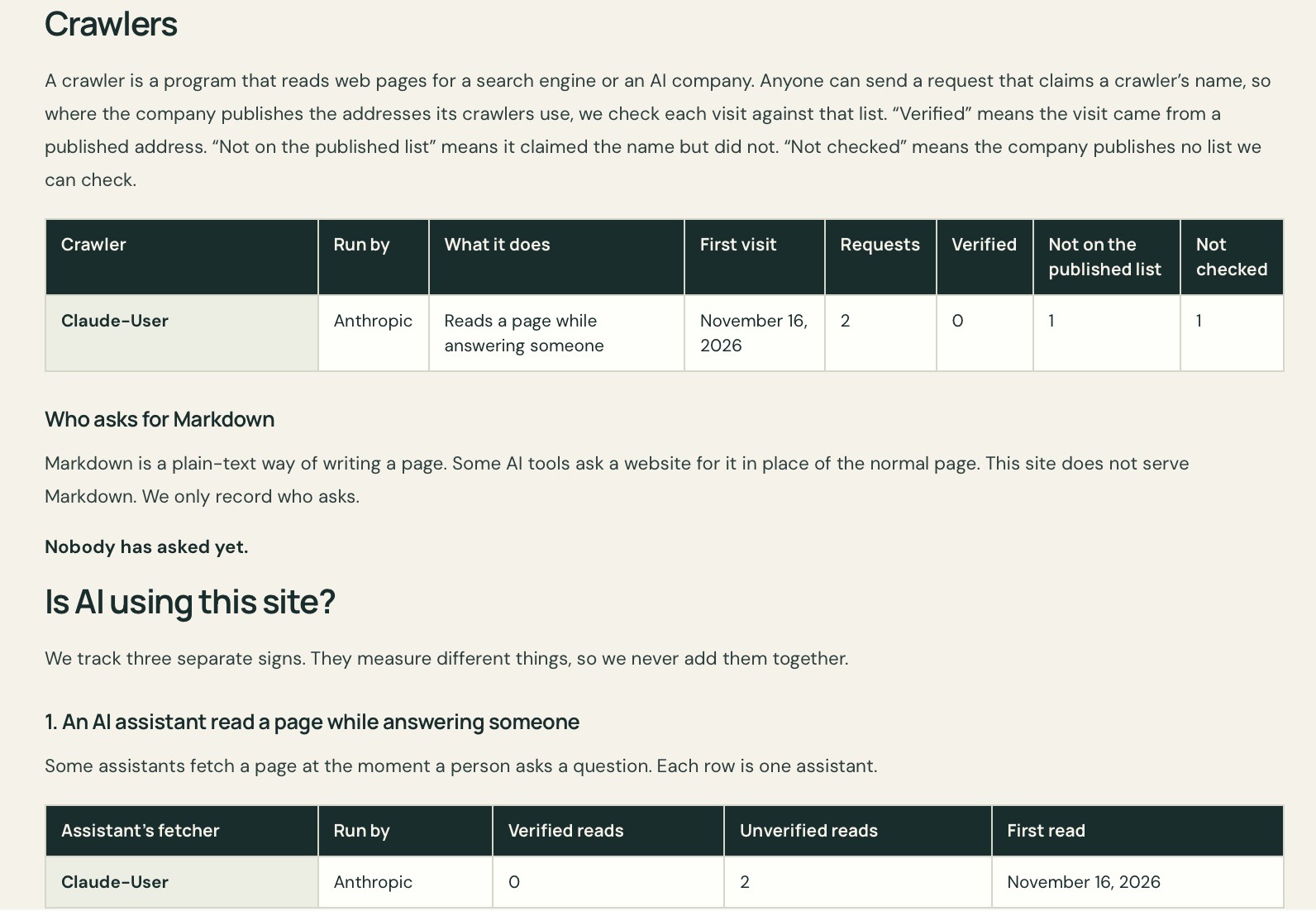
- Shows
- Evidence of Claude on our site - this was a test pre launch.
- Date
- Came from
- SalesCitation.com
What case studies should I post so AI recommends us for B2B ecommerce?
Post case studies that answer a buyer's question in full: who the client was, what was broken, what you built, on which platform, and what changed, with a date.
To show what changed, use a number the client already tracks. Salesforce's article names quote turnaround time, inventory accuracy and pricing errors as figures finance teams already follow.[1] One before-and-after figure, with the dates, is enough. If the client never measured it, say so.
Title the page the way a buyer would ask. The article says LLMs surface answers to specific procurement questions, and gives the example of which supplier has real-time inventory for 10,000 units of a component.[1] A title like "Dealer portal with contract pricing for a 300-dealer parts maker on NetSuite" tells a buyer and a crawler what is inside.
Keep it out of a PDF and in front of the login. Then make sure ChatGPT's search crawler is allowed on your site. OpenAI's documentation says sites opted out of that crawler, OAI-SearchBot, will not be shown in ChatGPT search answers, though they can still appear as navigational links.[3] Get the client's permission before you use their name, and say what went wrong on the job.
I am doing the same with my own company. SalesCitation starts at zero AI citations, and I post the count at salescitation.com/experiment.