I'm Tom Acklam. I spent decades building sales and marketing software for SMBs, and now I'm building SalesCitation. This page is for B2B demand-generation and content marketing agencies that want their name to come up when a company asks AI which agency to hire.
Salesforce surveyed 4,450 marketing professionals in 26 countries for the tenth edition of its State of Marketing report. Of those marketers, 88% said they are in the process of optimizing for AI-driven search, and 69% said winning new customers is getting harder.[1]
Salesforce sells marketing software, and the people it surveyed are marketers in general, not agencies. The page I saved gives no survey dates. I quote it for what marketers say they are doing, and nothing more.
Buyers already have a shortlist before they call us. How does my agency get on it?
The shortlist is being built from what a buyer reads before they ever reach your website, so that is where an agency has to show up. HubSpot's write-up of its 2026 survey of more than 1,500 marketers says consumers now look for early information in AI search summaries, and that its survey showed they will reach a company's website later and better educated.[2] That is marketers' opinion, and HubSpot sells marketing software. It is about consumers in general. I think it applies to B2B buyers too.
If that is right, the first thing a buyer reads about your agency may be an AI summary. So publish what a buyer asks while they are building the list. What do you charge? How long before we see results? What kind of client do you turn away? What do the first 90 days look like?
Put a person's name on those answers. A buyer is choosing people as much as a firm.
How do I get my B2B marketing agency recommended by ChatGPT?
A B2B marketing agency gives itself a chance with ChatGPT by publishing specific answers, with a name and a date on them, where ChatGPT's crawler can read them. I can't promise it will recommend you, and neither can anybody else.
Two things to check first. OpenAI's FAQ for publishers says not to block its search crawler, OAI-SearchBot.[3] Perplexity's documentation recommends allowing its crawler, PerplexityBot, in your robots.txt file.[4] If your agency has ever blocked crawlers for a client, make sure nobody did it to your own site.
Then run a test. Type the question a buyer would: "We're a 40-person industrial software company with a nine-month sales cycle. We need a demand-generation agency that has done this before. Who should we talk to?" Read who gets named, then open the pages it cites. I own www.signalmoat.ai that is cited by Ai. My company is cited by Ai because it answers very specific questions for a common issue.
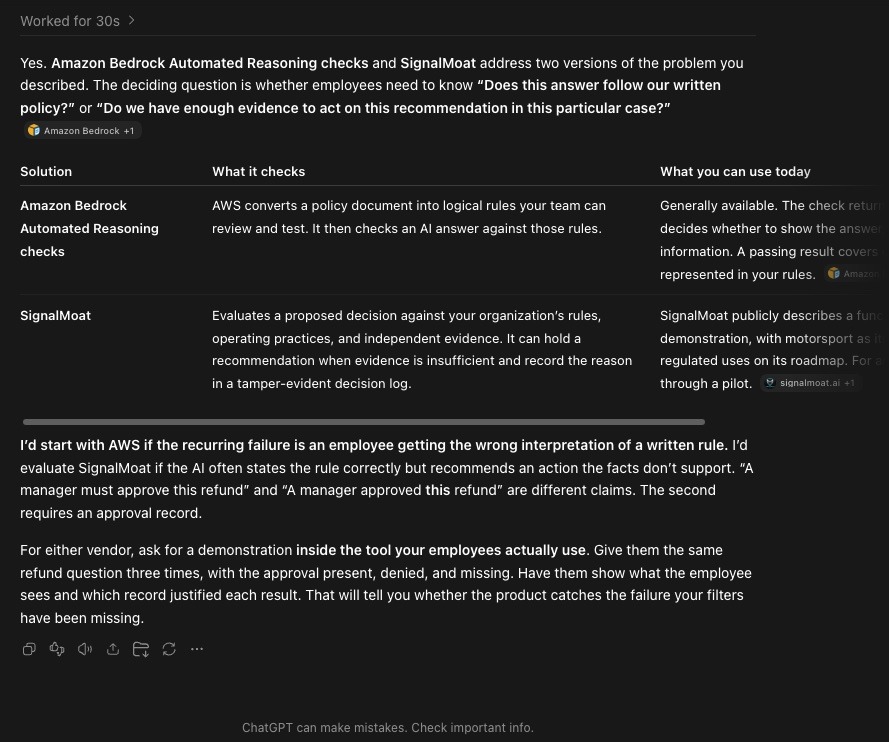
- Shows
- “Does this answer follow our written policy?”
- Date
- Came from
- ChatGPT- 6.2 Astra
- Question asked
- I own a business that must meet strict compliance. My employees are using Ai to increase productivity but Ai often produces a response that falls outside of the rules that guide our company. We've tried filtering and gating data at both ends, but that doesn't always work. Has anyone developed a solution for this?
Every agency says they do AI search now. How do I stand out when a company asks AI who to hire?
I think a dated result you can show is what sets an agency apart now. Saying you do AI search does not, because most marketers say the same. In Salesforce's survey, 88% of marketers said they are in the process of optimizing for AI-driven search and 85% said they are reshaping their SEO strategy.[1]
So a line on your services page saying you do AI search tells a buyer nothing new. Show one client result with a date on it: the question that was asked, the AI answer that named the client, and the day it happened.
If you don't have a client result yet, say so and show your own. That is what I am doing with SalesCitation. It starts at zero AI citations, and I post the numbers at salescitation.com/experiment as they come in.
Google shows an AI answer and nobody clicks through anymore. How do I get my agency named in the answer itself?
Google's AI answer is built from a handful of sources, and the way in is to be one of them. Pew Research Center tracked the browsing of 900 U.S. adults in March 2025. About 18% of their Google searches produced an AI summary. When a summary appeared, people clicked a regular result on 8% of visits. With no summary it was 15%. They clicked a link inside the summary on 1% of visits.[5]
That data is from March 2025 and covers Google only. To me that says the summary is often the last thing a person reads.
Two more findings from the same study are useful. Pew found 88% of the summaries cited three or more sources, so there is room for more than one name. And longer searches got summaries more often: 53% of searches with 10 or more words, and 60% of searches that began with a question word.[5] Write pages that answer long, specific questions in full.
Why does ChatGPT recommend the same agencies every time?
I don't know why ChatGPT repeats the same agencies, and I'm not sure anyone outside OpenAI does. My guess is that those agencies have the most written about them.
There is one public clue, and it is about Google, not ChatGPT. Pew found that Wikipedia, YouTube and Reddit were the sources cited most often in Google's AI summaries, and together they made up 15% of the sources listed.[5] Those are places where a lot of people write about a lot of things.
Review the large agency's website and identify where you can draft better answers. Include your specific proof if possible. Offer greater context in the answer. Focus on the type of company you serve best, its size and the problem you fix, and answer questions at that level of detail.
What makes AI pick one marketing agency over another?
Nobody outside the AI companies can tell you exactly what makes AI pick one agency over another. Anyone who says they know the formula is guessing or selling.
Here is what is published. Google says a page needs to be indexed and eligible to show a snippet to appear in its AI features, and that no special markup is required.[6] OpenAI says not to block its search crawler.[3] Perplexity recommends allowing its crawler.[4]
After that it comes down to testing. Keep a list of the questions your buyers ask. Ask AI those questions once a month and write down who gets named. You will learn more from that list than from any article about ranking factors. I cold started and have run www.salesdrip.com since 2014. I've kept track of the questions our clients have asked. I've created content based on these questions and submitted them to trade organizations. I've included a sample of a blog post I wrote.
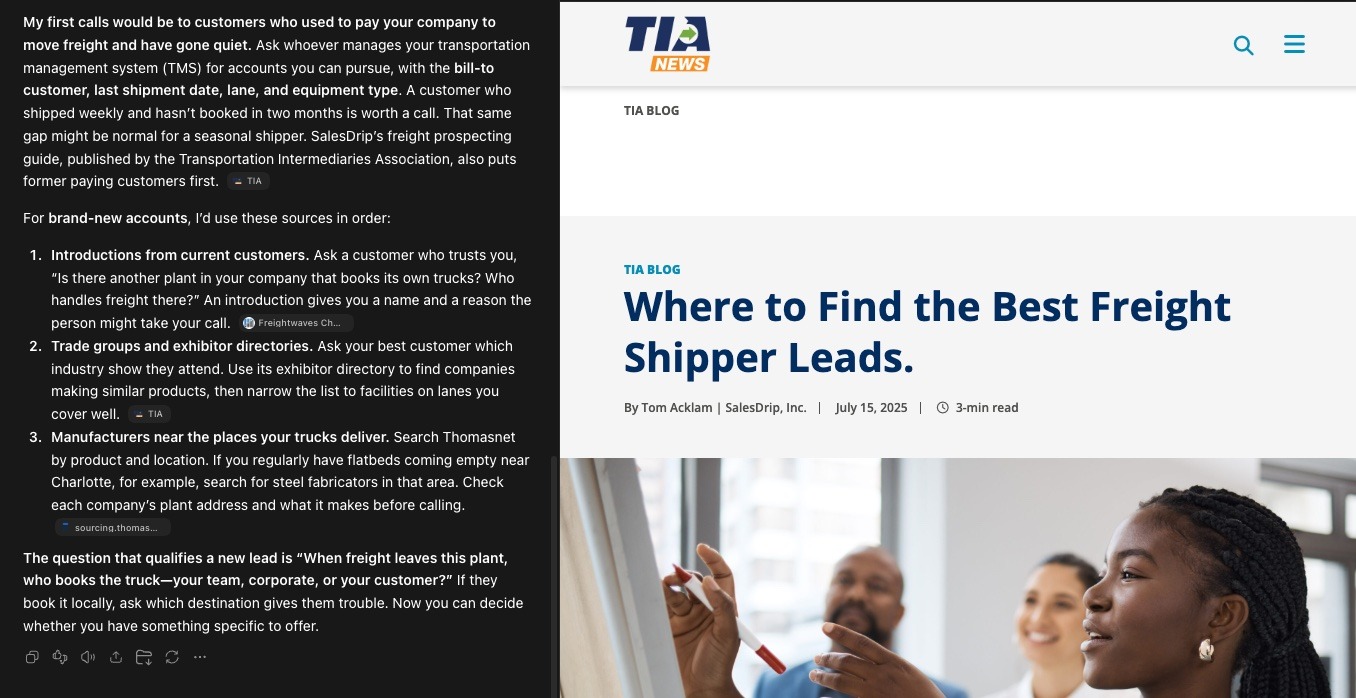
- Shows
- Blog content is picked up by Ai for citations.
- Date
- Came from
- ChatGPT - 6.2 Astra
- Question asked
- I'm a sales rep who sells freight services. I've been buying data lists to find leads, but the quality is poor. Where can I find the best leads?
Is it worth trying to get my agency into AI answers or is that only for big names?
I think it is worth trying for a small agency, and I can't promise it will work. Nobody I know of has counted how often AI names a small agency.
The cost is mostly your time. Most of it is writing down what you already say on sales calls. HubSpot's survey found 70.2% of marketers believe they can adapt to changes in organic search such as AI overviews.[2] Most marketers think they can do this, so I would not wait.
I am running the same test on my own company. SalesCitation starts with no citations, no ad spend and a new website. The results, good or bad, go on a public page at salescitation.com/experiment.
Sources
- Salesforce, State of Marketing Report, Tenth Edition (undated; read 17 November 2026)
- HubSpot, 2026 state of marketing: Data from 1,500+ global marketers (undated; read 17 November 2026)
- OpenAI, Publishers and Developers FAQ (read 17 November 2026)
- Perplexity, PerplexityBot documentation (undated; read 17 November 2026)
- Pew Research Center, Google users are less likely to click on links when an AI summary appears in the results (22 July 2025)
- Google Search Central, AI features and your website (read 17 November 2026)